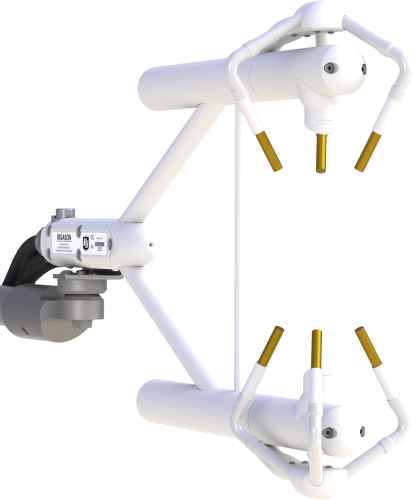
同时空测量的一体式气体分析仪和三维超声风速仪


概览
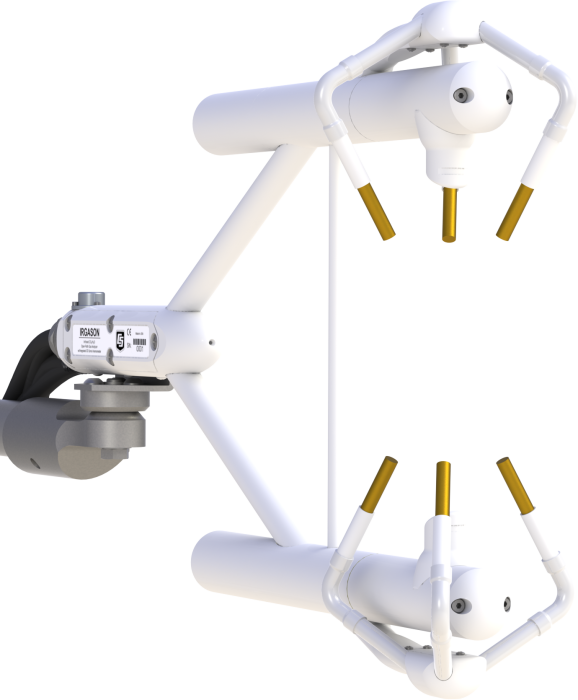
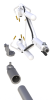
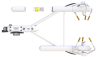
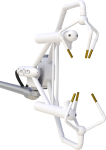
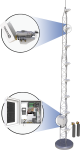
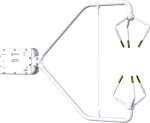
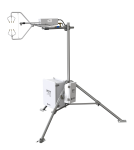
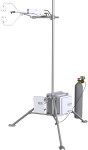
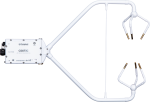
Campbell Scientific’s IRGASON®将开路分析仪与超声风速仪进行了完全集成。该设备专为涡动相关法碳通量与水通量测量设计,其专利设计(美国专利号:D680455)相比独立传感器,安装和使用更为简便,且测量精度更高。 IRGASON 可同时测量以下参数:二氧化碳绝对量、水蒸气绝对量、空气温度、大气压力、三维风速以及超声气温。
如需了解协同测量(collocated measurement)的优势详情,可参考海报 "通过开路气体分析仪与超声风速仪协同放置提升涡动通量测量效果"。
优势与特点
- New conformal coating helps protect sonic transducers in corrosive environments
- Combined support structure causes less flow distortion than two separate sensors
- Truly collocated gas analyzer and sonic anemometer measurements avoid flux loss due to sensor separation
- Synchronized gas analyzer and sonic anemometer measurements avoid the need to correct for time lag
- Low power consumption; suitable for solar power applications
- Temperature-compensated measurements without active heat control
- Low noise
- Maximum output rate of 60 Hz with 20 Hz bandwidth
- Angled windows to shed water; tolerant to window contamination
- Field rugged
- Field serviceable
- Factory calibrated over wide range of CO2, H2O, pressure, and temperature in all combinations encountered in practice
- Extensive set of diagnostic parameters
- Fully compatible with Campbell Scientific data loggers; field setup, configuration, and field zero and span can be accomplished directly from data logger
- Sonic temperature determined from three acoustic paths; corrected for crosswind effects
- Innovative signal processing and transducer wicks considerably improve performance of anemometer during precipitation events
图像

技术说明
IRGASON 可输出以下变量:
- Ux (m/s)
- Uy (m/s)
- Uz (m/s)
- 声温 (°C)
- 超声诊断值
- CO2 密度 (mg/m3)
- H2O 密度 (g/m3)
- 气体分析仪诊断值
- 环境温度 (°C)
- 大气压 (kPa)
- CO2 信号强度
- H2O 信号强度
产品规格
| Patent | U.S. Patent No. D680455 |
| Operating Temperature Range | -30° to +50°C |
| Calibrated Pressure Range | 70 to 106 kPa |
| Input Voltage Range | 10 to 16 Vdc |
| Power | 5 W (steady state and power up) at 25°C |
| Measurement Rate | 60 Hz |
| Measurement Rate | 100 Hz available upon request |
| Output Bandwidth | 5, 10, 12.5, or 20 Hz (user-programmable) |
| Output Bandwidth | 5, 10, 20, or 25 Hz available upon request (user-programmable) |
| Output Options | SDM, RS-485, USB, analog (CO2 and H2O only) |
| Auxiliary Inputs | Air temperature and pressure |
| Warranty | 3 years or 17,500 hours of operation (whichever comes first) |
| Cable Length | 3 m (10 ft) from IRGASON to EC100 |
| Weight |
|
Gas Analyzer |
|
| Path Length |
15.37 cm (6.05 in.) A temperature of 20°C and pressure of 101.325 kPa was used to convert mass density to concentration. |
Gas Analyzer - CO2 Performance |
|
| -NOTE- | A temperature of 20°C and pressure of 101.325 kPa was used to convert mass density to concentration. |
| Accuracy |
|
| Precision RMS (maximum) |
0.2 mg/m3 (0.15 μmol/mol) Nominal conditions for precision verification test: 25°C, 86 kPa, 400 μmol/mol CO2, 12°C dewpoint, and 20 Hz bandwidth |
| Calibrated Range | 0 to 1,000 μmol/mol (0 to 3,000 μmol/mol available upon request) |
| Zero Drift with Temperature (maximum) | ±0.55 mg/m3/°C (±0.3 μmol/mol/°C) |
| Gain Drift with Temperature (maximum) | ±0.1% of reading/°C |
| Cross Sensitivity (maximum) | ±1.1 x 10⁻⁴ mol CO2/mol H2O |
Gas Analyzer - H2O Performance |
|
| -NOTE- | A temperature of 20°C and pressure of 101.325 kPa was used to convert mass density to concentration. |
| Accuracy |
|
| Precision RMS (maximum) |
0.004 g/m3 (0.006 mmol/mol) Nominal conditions for precision verification test: 25°C, 86 kPa, 400 μmol/mol CO2, 12°C dewpoint, and 20 Hz bandwidth |
| Calibrated Range | 0 to 72 mmol/mol (38°C dewpoint) |
| Zero Drift with Temperature (maximum) | ±0.037 g/m3/°C (±0.05 mmol/mol/°C) |
| Gain Drift with Temperature (maximum) | ±0.3% of reading/°C |
| Cross Sensitivity (maximum) | ±0.1 mol H2O/mol CO2 |
Sonic Anemometer - Accuracy |
|
| -NOTE- | The accuracy specification for the sonic anemometer is for wind speeds < 30 m s-1 and wind angles between ±170°. |
| Offset Error |
|
| Gain Error |
|
| Measurement Precision RMS |
|
| Speed of Sound | Determined from three acoustic paths (corrected for crosswind effects) |
| Rain | Innovative signal processing and transducer wicks considerably improve performance of anemometer during precipitation events |
Basic Barometer (option -BB) |
|
| Total Accuracy |
|
| Measurement Rate | 10 Hz |
Enhanced Barometer (option -EB) |
|
| Manufacturer | Vaisala PTB110 |
| Total Accuracy | ±0.15 kPa (-30° to +50°C) |
| Measurement Rate | 1 Hz |
Ambient Temperature |
|
| Manufacturer | BetaTherm 100K6A1IA |
| Total Accuracy | ±0.15°C (-30° to +50°C) |
相关技术文档
技术论文
- The IRGASON Advantage
- EC150, IRGASON, or EC155: Which CO2 and H2O Eddy-Covariance System Is Best for My Application?
- Molecular Sieve CO2 and H2O Scrubbing Solution
- Recovery of the three-dimensional wind and sonic temperature data from a physically deformed sonic anemometer
- Eddy Covariance Hardware Troubleshooting — Preparing for a Site Visit
规约
技术文档
- Improved Flux Measurements from Campbell Scientific Open-Path Gas Analyzers: Utilizing Sonic Temperature to Account for Spectroscopic Effects on CO2 Density
- Influence of Open-path Gas Analyzer Flow Distortion on Ultrasonic Wind Measurements
- Qingyuan Project Update
- IRGASON and EC150 Source and Detector Cover Updates
- Application of flux footprint equations from Kljun et al. (2015) to field eddy-covariance systems for footprint characteristics into flux network datasets
下载
EasyFlux DL for CR6OP v.2.02 (99.2 KB) 31-10-2025
CR6 datalogger program for Campbell open-path eddy-covariance systems.
EasyFlux DL for CR6OP (CMA) v.1.01 (56.1 KB) 22-02-2022
CR6 datalogger program for Campbell open-path eddy-covariance systems.
Note: This version is customized for CMA flux format only.
EC100 OS v.8.02 (560 KB) 14-10-2019
EC100 Operating System.
Watch the Video Tutorial: Updating the EC100 Operating System.
ECMon v.1.6 (10.7 MB) 29-03-2016
EC100-Series Support Software.
Device Configuration Utility v.2.36 (52.1 MB) 17-09-2026
A software utility used to download operating systems and set up Campbell Scientific hardware. Also will update PakBus Graph and the Network Planner if they have been installed previously by another Campbell Scientific software package.
Supported Operating Systems:
Windows 11 or 10 (Both 32 and 64 bit)
EasyFlux DL for Open-Path Eddy-Covariance System using a CR1000X(e) v.2.02 (99.2 KB) 31-10-2025
CR1000X(e) datalogger program for Campbell open-path eddy-covariance systems.
常见问题解答
IRGASON: 22
展开全部收起全部
-
The factory calibration accounts for CO2 and H2O signal strengths down to 0.7. Therefore, to ensure quality data, windows should be cleaned before signal strengths drop below 0.7.
-
The IRGASON™ has been optimized for most terrestrial applications. If the IRGASON is to be used in a marine environment or in an environment where it is exposed to corrosive chemicals (for example, sulfur-containing compounds in viticulture), expect the sonic transducers to age more quickly and require replacement sooner than a unit deployed in an inland, chemical-free environment. If possible, mount the IRGASON in a way that reduces exposure to saltwater spray/splash and/or corrosive chemicals.
-
Selecting which barometer to use is the choice of the user. There is a direct correlation between the accuracy level of the barometer and its cost.
- The basic barometer has an accuracy of ±1.5 kPa between 0° and 50°C. Below 0°, the error increases linearly to ±3.7 kPa at -30°C.
- The enhanced barometer offers an accuracy of ±0.15 kPa (-30° to +50°C).
When choosing a barometer, consider the effect of pressure accuracy on flux calculations. For sensible heat flux, the barometric pressure is used to calculate the density of air, which directly scales the sensible heat flux. Therefore, if the barometric pressure measurement is off by 1%, then the sensible heat flux will be off by 1%.
For CO2 flux, the EC150 and IRGASON™ report CO2 as density. Thus, the barometric pressure is not used to directly calculate the flux. However, error in pressure measurements could cause an error in CO2 flux resulting from a CO2 span. During the span procedure, the user enters the “true CO2 value” as a CO2 concentration, which is later converted to density using the barometric pressure. Consequently, the error in CO2 measurements is directly proportional to the error in the barometric pressure measurement.
-
To zero the analyzer of an EC150 or an IRGASON™, any gas that is free of CO2 or H2O, such as nitrogen gas, will work. To span CO2, use mixtures of CO2 in air. It is important that air, not pure nitrogen, be used as the balance gas, so that the pressure-broadening characteristics match that of ambient air. Ideally, use a CO2 span gas concentration that is close to the expected concentration that will be measured at the site.
-
The EC150 and IRGASON™ gas analyzer windows are polished, slanted at an angle, and coated with a hydrophobic material to prevent water from collecting on their surfaces. Wicks may also be used on the windows to promote capillary action and move water away from the window edges. Also, heaters in the snouts may be turned on to help minimize data loss because of precipitation and condensation events.
-
The frequency at which a zero/span should be done is highly dependent on site conditions; however, a monthly zero/span is a good starting point. As a general guideline, monitor the optical drift of the instrument over time to determine how often a zero/span procedure needs to be performed.
-
For greatest accuracy, Campbell Scientific recommends that a zero and a span be done on the EC150 or IRGASON™. However, if a span gas is difficult to obtain, at the minimum, perform a zero on the analyzer. Performing a zero will correct the majority of drift experienced by the analyzer. Follow the zero procedure in the analyzer’s manual for details.
-
Yes. A fine-wire thermocouple, such as a FW05, can be used.
-
Factory recalibration is done on an as-needed basis. When diagnostic flags begin to appear and persist even after cleaning the analyzer and verifying its settings, a recalibration is needed. Additionally, if the performance of the analyzer has degraded, a recalibration is recommended.
One performance test is to check the absolute signal strength drift over the course of 1 year. Drift of a few percent per year is normal. If the annual signal strength drift is excessive, or if the signal strength is below 0.7 when the windows are clean, a factory recalibration is needed. Furthermore, if the ratio of the CO2 to H2O signal strength is not close to one, it may also be time for a factory recalibration.
-
EdiRe (University of Edinburgh) and MATLAB (MathWorks) are two of the products eddy-covariance customers have used to post-process their data. Others are also available. (For more information, review the EdiRe technical paper titled “EdiRe Software for Micrometeorological Applications.)
Campbell Scientific’s default data output format is TOB1 binary, which is compatible with most post-processing software packages. If another data format is needed, Campbell Scientific’s LoggerNet software may be used to convert TOB1 to another format.
案例研究
Overview The Valencia Anchor Station (VAS), operated by the University of Valencia, is one of Europe’s......阅读更多
As part of their work on evapotranspiration measurements, Cerema Ile-de-France sought to test different measurement......阅读更多
Understanding the spatial variability of the Earth’s atmospheric boundary layer—including the surface layer near the......阅读更多

Overview In the fight against climate change, innovative solutions are emerging to address the global challenge......阅读更多
The Utah Geological Survey, supported by the Utah Division of Water Rights, has constructed a......阅读更多
The Wolf Creek Dam near Jamestown, Kentucky, was constructed partially as a regular concrete hydroelectric......阅读更多