
在高容积电导率土壤中的精度更高


概览
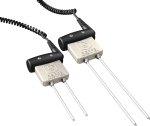
CS650 是多参数智能传感器,使用革新的技术监测土壤体积含水量、容积电导率和土壤温度。它的信号输出方式为SDI-12,可用于 Campbell Scientific 大多数数据采集器。
备注:如果用于ET107气象站,请选择CS650-LC 。
优势与特点
- 更精确的土壤含水量测量,容积电导率可达 3 dS m-1,无需实施特定土壤校准
- 更大的采集体积,减少了误差
- 对土壤质地和电导率的影响进行测量修正
- 估算很多种矿质土类型土壤中的含水量
- 多功能的传感器 — 可测量介电常数、容积电导率(EC)和土壤温度
图像

技术说明
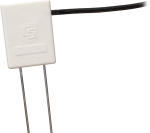
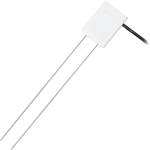
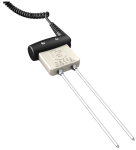
CS650含有连接到印刷电路板的2根30 cm长的不锈钢探针。电路板用环氧树脂封装,附着在电路板的带屏蔽线缆提供与数据采集器的连接。
CS650测量传输时间、信号衰减和温度;再从这些原始测量值解析得到介电常数、体积含水量和容积电导率。
测量的信号衰减是用于反射检测的损失效应及传播时间的修正。损失效应修正可以让探头在容积电导率 ≤3 dS m-1 的土壤中,测量出高精度的体积含水量,并不需要实施特定的土壤校准。
由衰减测量还可以计算得到土壤容积电导率。靠近环氧树脂表面的与探针保持热接触的热敏电阻用来测量温度。如果传感器水平安装,可以得到与土壤含水量测量相同深度的精确温度测量。如果以其它的方位安装传感器,那么温度测量只能代表环氧树脂附近探针的区域。
产品规格
| Measurements Made | Soil electrical conductivity (EC), relative dielectric permittivity, volumetric water content (VWC), soil temperature |
| Required Equipment | Measurement system |
| Soil Suitability | Long rods with large sensing volume (> 6 L) are suitable for soils with low to moderate electrical conductivity. |
| Rods | Not replaceable |
| Sensors | Not interchangeable |
| Sensing Volume | 7800 cm3 (~7.5 cm radius around each probe rod and 4.5 cm beyond the end of the rods) |
| Electromagnetic |
CE compliant Meets EN61326 requirements for protection against electrostatic discharge and surge. |
| Operating Temperature Range | -50° to +70°C |
| Sensor Output | SDI-12; serial RS-232 |
| Warm-up Time | 3 s |
| Measurement Time | 3 ms to measure; 600 ms to complete SDI-12 command |
| Power Supply Requirements | 6 to 18 Vdc (Must be able to supply 45 mA @ 12 Vdc.) |
| Maximum Cable Length | 610 m (2000 ft) combined length for up to 25 sensors connected to the same data logger control port |
| Rod Spacing | 32 mm (1.3 in.) |
| Ingress Protection Rating | IP68 |
| Rod Diameter | 3.2 mm (0.13 in.) |
| Rod Length | 300 mm (11.8 in.) |
| Probe Head Dimensions | 85 x 63 x 18 mm (3.3 x 2.5 x 0.7 in.) |
| Cable Weight | 35 g per m (0.38 oz per ft) |
| Probe Weight | 280 g (9.9 oz) without cable |
Current Drain |
|
| Active (3 ms) |
|
| Quiescent | 135 µA typical (@ 12 Vdc) |
Electrical Conductivity |
|
| Range for Solution EC | 0 to 3 dS/m |
| Range for Bulk EC | 0 to 3 dS/m |
| Accuracy | ±(5% of reading + 0.05 dS/m) |
| Precision | 0.5% of BEC |
Relative Dielectric Permittivity |
|
| Range | 1 to 81 |
| Accuracy |
|
| Precision | < 0.02 |
Volumetric Water Content |
|
| Range | 0 to 100% (with M4 command) |
| Water Content Accuracy |
|
| Precision | < 0.05% |
Soil Temperature |
|
| Range | -50° to +70°C |
| Resolution | 0.001°C |
| Accuracy |
|
| Precision | ±0.02°C |
兼容性
Please note: The following shows notable compatibility information. It is not a comprehensive list of all compatible products.
数据采集器
| Product | Compatible | Note |
|---|---|---|
| CR1000X (retired) | ||
| CR300 (retired) | ||
| CR3000 (retired) | ||
| CR310 | ||
| CR350 | ||
| CR6 | ||
| CR800 (retired) | ||
| CR850 (retired) |
Additional Compatibility Information
射频考虑
外部的射频源
外部的射频源会影响探头的工作;因此,探头的位置应当远离明显的射频源,例如交流电线及电机。
探头间干扰
多个 CS650 传感器的相互之间的安装距离小于4 英寸,当使用标准的数据采集器 SDI-12 “M” 命令时。SDI-12 “M” 可以使得一次只激活一个探头。
安装工具
在密实或基岩性土壤中,使用 CS650G 工具会让安装CS650探头更容易。将CS650 敲入土壤中,钻出平行小孔(与CS650 探针间距一致),再将CS650 插入,可以最大可能避免损坏CS650传感器。
数据采集器考虑
可兼容的当代数据采集器
| CR200(X) 系列 | CR800/CR850 | CR1000 | CR3000 | CR7X | CR9000X | CR6 |
 |
|
|
|
|
Compatible Retired Dataloggers
| CR500 | CR510 | CR10 | CR10X | 21X | CR23X | CR5000 | CR9000 |
|
|
|
|
|
|


下载
CS650 / CS655 Firmware v.2 (429 KB) 02-12-2015
Current CS650 and CS655 firmware.
Note: The Device Configuration Utility and A200 Sensor-to-PC Interface are required to upload the included firmware to the sensor.
常见问题解答
CS650: 50
展开全部收起全部
-
No. It is not possible to disable the logical tests in the firmware. If soil conditions cause frequent NAN values, it may be possible to perform a soil-specific calibration that will provide good results.
If permittivity is reported but the volumetric water content value is NAN, Campbell Scientific recommends a soil-specific calibration that converts permittivity to water content. This will take advantage of the bulk electrical conductivity correction that occurs in the firmware.
If both permittivity and volumetric water content have NAN values, it may be possible to perform a calibration that converts period average directly to volumetric water content.
For details on performing a soil-specific calibration, refer to “The Water Content Reflectometer Method for Measuring Volumetric Water Content” section in the CS650/CS655 manual. After a soil-specific equation is determined, it may be programmed into the data logger program or used in a spreadsheet to calculate the soil water content.
-
Modifications to the CS650 or CS655, including shortening the cable, will void the warranty. However, shortening the cable will not affect the sensor’s performance. If a decision is made to shorten the cable, care should be taken to avoid damaging the cable jacket and exposing bare wire except at the ends that connect to the data logger or multiplexer terminals.
-
Yes, but the pots would have to be large. The CS650 and CS655 can detect water as far away as 10 cm (4 in.) from the rods. If the pot has a diameter smaller than 20 cm (8 in.), the sensor could potentially detect the air around the pot, which would underestimate the water content. In addition, potting soil is typically high in organic matter and clay, causing the probable need for a soil-specific calibration.
-
No. The principle that makes these sensors work is that liquid water has a dielectric permittivity of close to 80, while soil solid particles have a dielectric permittivity of approximately 3 to 6. When liquid water freezes, its dielectric permittivity drops to 3.8, essentially making it look like soil particles to the sensor. A CS650 or CS655 installed in soil that freezes would show a rapid decline in its volumetric water content reading with corresponding temperature readings that are below 0°C. As the soil freezes down below the measurement range of the sensor, the water content values would stop changing and remain steady for as long as the soil remains frozen.
-
No. The temperature sensor is located inside the sensor’s epoxy head next to one of the sensor rods. The stainless-steel rods are not thermally conductive, so the reported soil temperature reading is actually the temperature of the sensor head. If the CS650 or the CS655 is installed horizontally, which is the preferred method, then the sensor head will be at the same temperature as the soil, and the soil temperature value will be accurate. However, if the sensor is installed vertically, and/or with the sensor head above ground, the soil temperature reading will be less accurate. Because the sensor orientation is not known, no temperature correction was written into the firmware.
-
Three of the values returned by the M3! command are never changed to NAN by logical tests. If non-zero readings for soil temperature, period average, and voltage ratio are displayed, the sensor is working.
A simple test in air and water will also show whether the CS650 or CS655 is functioning. When performing this test, look at the permittivity value and not the water content value. In air, the sensor will read a permittivity value of 1. In room-temperature water, the value should be close to 80. The water container should have a diameter of at least 20 cm (8 in.) and a depth of 33 cm (13 in.). A smaller container will result in a lower permittivity value because the sensor will be measuring some of the air outside the container as well as the water. Tap water is acceptable for this test.
-
The CS650-series sensors have the same rugged epoxy and stainless-steel rods that have been used for water content reflectometers since the CS615-L model was introduced in 1995. There are CS615-L and CS616 sensors in many locations that have been in continuous use for more than ten years with no reported problems. If a CS650 or CS655 remains undamaged by external forces such as lightning, harsh chemicals, or animal actions, the sensor is expected to continue working for decades.
-
If a system has multiple CS650 or CS655 sensors, it will be necessary to connect many wires to a 12 V supply and many wires to ground. The DIN Rail Mounting Kit is useful for attaching many wires to the same source in a clean and organized way. For more details, see the 5458 DIN Rail Terminal Kit instruction manual.
Other methods of connecting several wires together, such as terminal strips or wire nuts, would also work.
-
The bulk electrical conductivity (EC) measurement is made along the sensor rods, and it is an average reading of EC over that distance at whatever depth the rods are placed.
-
Campbell Scientific strongly discourages shortening the sensor’s rods. The electronics in the sensor head have been optimized to work with the 30 cm long rods. Shortening these rods will change the period average. Consequently, the equations in the firmware will become invalid and give inaccurate readings.
案例研究

Everglades National Park is the largest tropical wilderness in the United States and was created......阅读更多
Agrivoltaics or dual-use solar is a system combining an agricultural crop (viticulture, arboriculture, field crops,......阅读更多